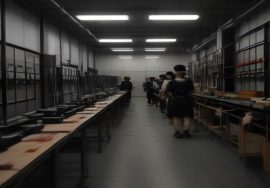


2026 Factory Anti-Mold & Anti-Bacterial Solutions: Ai Haoer iHeir Long-Lasting Protection Reduces Costs and Boosts Productivity
[Executive Summary] Factory environments combine high humidity, dense raw materials, and multi-stage processing—making them prime breeding grounds for mold and bacteria. Ai Haoer iHeir, backed by years of industrial antimicrobial service experience and its iHeir Anti-Mold & Antibacterial Laboratory, provides factories with end-to-end anti-mold and anti-bacterial protection. This article reviews the key risks and practical pathways of factory anti-mold and anti-bacterial solutions in 2026.

1. Why Factories Are High-Risk for Mold & Bacteria?
Factory floors present multiple triggers for mold proliferation. According to long-term monitoring data from the Ai Haoer Anti-Mold & Antibacterial Technology Research Center, when relative humidity exceeds 65% and temperature stays between 20°C–32°C, mold spores can germinate on raw material surfaces within 24 hours. Once materials or finished products remain in a workshop for more than 48 hours, microbial contamination risk rises exponentially.
Key risk factors include:
- Raw material baseline load. Leather, cotton, linen, wood, paper, and natural rubber all carry microbial populations; handling and stacking easily introduce secondary contamination.
- Workshop microclimate. Poor ventilation in large halls, pipe condensation, and rising ground moisture create isolated “mold islands” that can quickly spread across a batch.
- Cross-process exposure. From cutting and assembly to inspection and packaging, every step introduces contamination risk if the previous step was not controlled.
- Export compliance pressure. Buyers in Europe, the Americas, the Middle East, and Southeast Asia enforce zero-tolerance mold inspection; failed customs clearance means rejections and claims.

2. Ai Haoer’s End-to-End Factory Anti-Mold & Anti-Bacterial Solution
Ai Haoer has structured its factory anti-mold and anti-bacterial service into a four-stage closed-loop:
a. Raw material pre-treatment at intake. Natural raw materials such as leather, wood, and textiles are pre-treated with Ai Haoer anti-mold & antibacterial additives before storage, suppressing spore germination and cutting off the contamination source at its origin.
b. Dynamic workshop environment management. Ai Haoer deploys antibacterial sprays and anti-mold hanging tablets on air, floors, equipment surfaces, and tools, combined with real-time temperature and humidity monitoring, creating an “anti-mold & antibacterial environmental field” throughout production.
c. Finished-goods inspection and treatment. Before packaging, the packaging liner, labels, and instructions are simultaneously treated with Ai Haoer iHeir anti-mold agents. Sealed packages undergo 24-hour mold culture testing; only products meeting pass criteria leave the factory.
d. End-to-end warehousing protection. Once products enter finished-goods storage, Ai Haoer anti-mold tablets, cards, and films are deployed alongside dehumidification, ventilation, and IoT sensors, bringing warehousing-period mold risk to a minimum.

3. Ai Haoer’s Technical Advantages
- Patented formulations. Ai Haoer’s research center holds multiple national patents; its core ingredients deliver long-lasting antimicrobial performance at low dosage.
- Customized programs. Tailored solutions for leather, textiles, wood, food-contact, and electronics industries, flexibly matched to budget and site conditions.
- International certifications. Products pass SGS, FDA, REACH, and other authoritative tests, meeting EU and US export compliance requirements.
- Nationwide service network. Ai Haoer operates service hubs across East, South, Central, and Southwest China, enabling fast on-site factory response.
4. Industry Application Cases
Leather goods factory: A South China leather goods manufacturer reduced finished-product mold spots by 85% and export rejection rates by 60% year-on-year after adopting Ai Haoer’s factory anti-mold program.
Wood furniture factory: A North China wood furniture maker saved over 1 million RMB annually in mold-related scrap loss through Ai Haoer workshop remediation.
Textile warehousing facility: A Jiangsu–Zhejiang textile company reduced summer warehousing mold complaints by more than 90% after deploying Ai Haoer’s warehouse anti-mold system.
Precision electronics workshop: Ai Haoer provides residue-free antibacterial treatment for precision electronic components, ensuring surfaces and packaging meet RoHS and REACH specifications.
5. 2026 Factory Anti-Mold & Anti-Bacterial Trends
1. Proactive prevention replaces reactive treatment. The “fix it once mold appears” model is being replaced by “prevent throughout the process”—anti-mold and anti-bacterial protection is becoming standard factory operations.
2. End-to-end integration. One-stop solutions from raw material intake to warehousing will dominate; Ai Haoer is actively piloting fully managed factory anti-mold programs.
3. Data-driven & AI-powered. Integration with IoT sensors and AI-based early-warning systems enables digital, predictive anti-mold management.
4. Eco-friendly antimicrobial agents. Fluorine-free, formaldehyde-free, low-VOC antimicrobial formulations are set to become the mainstream in 2026.
Conclusion
Anti-mold and anti-bacterial protection is no longer optional for factories—it is a must-have for quality, cost control, and compliance. Partnering with a professional provider like Ai Haoer iHeir, from raw material intake to warehouse outbound, provides factories with long-lasting protection, cost reduction, and sustainable brand growth.
Learn more: 2026 Anti-Mold & Anti-Bacterial Trends | 2026 Warehousing & Logistics Anti-Mold Trends | Ai Haoer Product Center